Latest MS research – what I learned at ECTRIMS, part 2

xcel

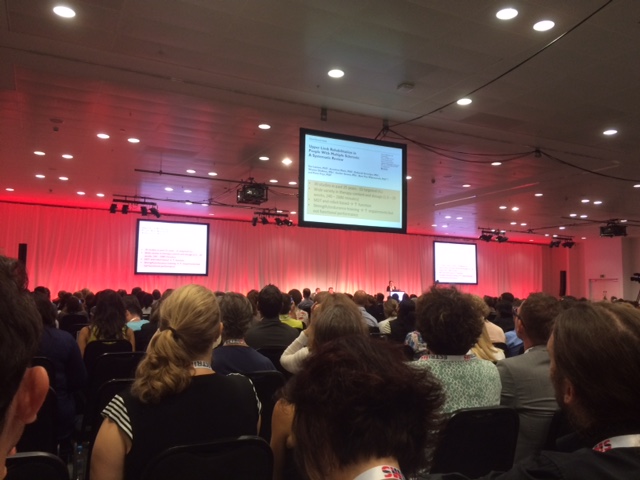
Wow, what a full on 3 days for the brain! So inspiring to see a sea of research posters, a vast menu of presentations , and 8000 engaged delegates filling up on the latest research.

Bone marrow transplantation ( HSCT/stem cell) – is it a viable treatment for active relapsing remitting MS – debateimg_3970
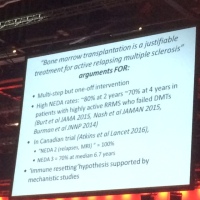
Consensus was: safety is improving – from 2011 the mortality rate has been 0.3% rather than 1-2%. Due to impressive rates of NEDA ( no evidence of disease activity – relapses or on MRI) – 80% at 2 years and 70% at 4 years in one study;

Yes, but ONLY in cases of early/new, highly active/aggressive relapsing remitting MS, where person is young, still walking, and treatment with first & second line treatment have failed.

And now for something completely different, and please DO try this at home(!): Seriously, I will be

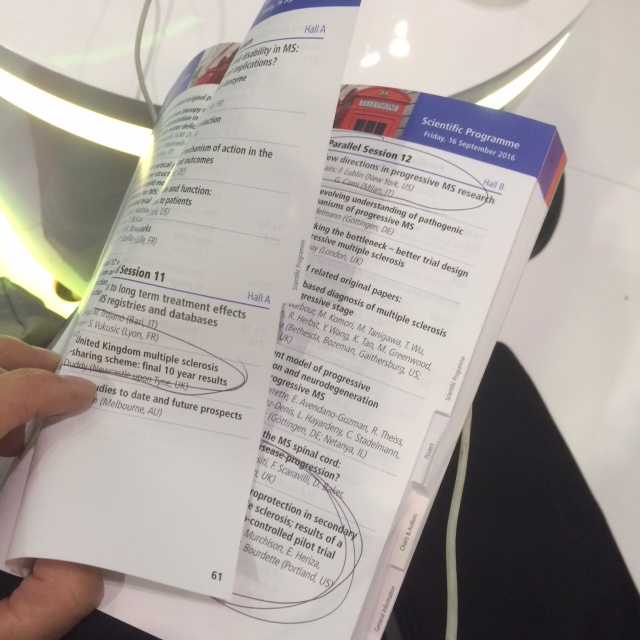
Lipoic acid for neuroprotection in secondary progressive multiple sclerosis: results of a randomised placebo-controlled pilot trial –  R.I. Spain (Portland, United States) lipoic-acid
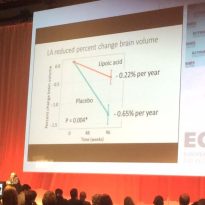
This beautifully carried out RCT had people with progressive forms of MS taking 1,200mg of Lipoic Acid, a supplement often sold as an ‘anti-oxidant’, and also called ‘alpha-lipoic acid’ once a day. A control group took a placebo.

After 2 years, the group taking the lipoic acid had a whopping 66% less brain atrophy on MRI scan ( showing less loss of brain cells), taking them back to a normal rate of brain atrophy, and half the number of falls.

Love it when something so harmless is investigated properly and found effective. Especially good to have something positive for progressive MS!

Comparison of Beta Interferons, Fingolimon, Alemtuzemab (Lemtrada) and Natalizumab ( Tysabri)

showed that as we know, effectiveness in reducing relapses from lowest up goes: Interferons, then Fingolimod, then Alemtuzemab and Tysabri. The last 2 showed the same effectiveness in preventing relapses. Natalizumab also showed improvement in disability in the first year, but not after that. and as we now the side effect profile and the way you take it is very different. Tysabri also has a rebound effect if and when you stop taking it. 

Alemtuzemab

research was presented that showed this drug performing very well in ‘resetting’ the immune system. Around 60% of people did not need more than 2 infusions, and NEDA ( no evidence of disease activity) was very high., but only when used EARLY. Time to change from the ‘wait and see’ attitude? This is the push from leading MS experts. Maybe check in with the MS Brain Health campaign if your neurologist is dragging their feet.

Vitamin D vit D.jpg
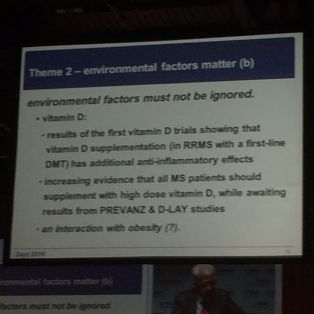
very strong evidence coming through from numerous sources that notwithstanding previous medical controversies and uncertainties, all people with MS should be on high dose from diagnosis – 4-5000 IU daily at least, and testing ( backs up info already posted on this blog) MS Base ( a database with over 41,000 people with MS’s records) showed a clear seasonal peak in relapses around the world, at the end of winter; with a time lag, shorter in colder countries. Low vitamin D levels were the strongest risk for progression in another study, and added a further anti inflammatory effect to people already on a disease modifying treatment, in another.

One study found that  people with MS given 100,000 twice a month for 2 years had a 60% reduction in relapse rate, and a 78% reduction in new lesions, compared to placebo. Powerful stuff, hopefully enough to finally swing the doubters.

Siponimod for progressive MS

presented as promising new treatment but I missed that session so – investigate!

Scientific highlights presentation – was split into 3 sections ‘migration and CNS injury’, ‘Gut and Food’ and ‘remyelination and oligodendracytes’

At the end of the event, I was really surprised to see these slides in the highlights – I missed the full presentation but one slide went like this:
hb02Oxygen

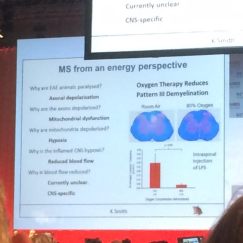
MS from an energy perspective.

Q:Why are animals with experimental animal MS paralysed?

A: Axonal ( nerve) depolarisation ( can’t send messages)

Q Why are axons depolarised?

A: Hypoxia ( lack of oxygen)

Q: Why is the inflamed central nervous system hypoxic?

A: Reduced blood flow

Q Why is blood flow reduced?

A: Currently unclear , CNS specific ( ie we don’t know, but it’s just the central nervous system.)

Went on to describe how animals with this experimental model of MS respond very well to hyperbaric oxygen: Oxygen therapy reduces pattern 3 demyelination.

So maybe we will see some new research showing usefulness of hyperbaric oxygen? If you can access it, I always say that it’s worth trying, and observe the effects on yourself.

Diet and Gut in MS

Feels like finally, the importance of aspects of diet is being addressed and listened to in MS research. In fact all present were enjoined Not to ignore environmental factors. Hurrah! a strike for logical thinking!

This was a feature of quite a lot of research at ECTRIMS. Lots of research on the role of the Biome ( bacteria in the gut) and how it affects MS. Interesting, exciting, but we still haven’t nailed practical application yet, so best bet is Take a daily probiotic capsule or powder, with as many different strains in as possible. And do these things, discussed previously.

Being overweight was identified as a serious risk factor for both developing, and worsening with MS. If you’ve got pounds to lose, check out the excellent ‘Fast Diet/ 5:2 diet’, showcased by Micheal Moseley on the BBC -https://thefastdiet.co.uk/ fasting also has benefits for inflammatory conditions.

Salt:  

salt stored in the skin was posed as a driver for auto-immune neuroinflammation in one paper. People with MS were found to have higher levels of salt in the skin….so that too… we could all cut down our salt – most is found in processed foods… and as you do it, your tastebuds acclimatise so it won’t mean you won’t taste your food.

Ending on a high

Conference ended on a high note, celebrating the huge progress that has been made in preventing disability – progress that started even before the availability of the disease modifying drugs, but has in recent years added a further 15 years of non-disabled life to the average MS-er, and is still making leaps and bounds.

I hope I’ve made an accurate summary of the sessions that I attended – mistakes are possible, and they will be all  mine. If you spot one, please let me know!

That’s all for now, til the next time!

miranda


What I learned at ECTRIMS: part 1

Hellectrims-webo from the 32nd congress of ECTRIMS, & the 21st conference of Rehabilitation in MS.
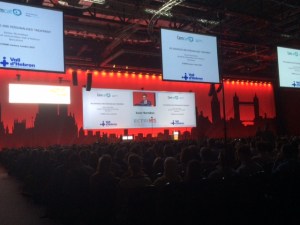


ECTRIMS is ‘ Europe’s and the world’s largest professional organisation dedicated to the understanding and treatment of multiple scelrosis’

With over 8000 delegates, all specialising, of with a special interest, in MS, it’s a privilege to attend! Loads of lectures run concurrently, so you can never attend everything. And the really science-y lectures, that are not yet going to make a practical difference to my patients, tend to go over my head a bit. Or a lot, depending! So here’s a digest of what I’ve learned so far, that has a practical application for people with MS!

The intro – X. Montalban (Spain)ectrims

Good to hear the current aims:

  • Evolving the Diagnosis of MS, so it can be made more quickly, but still be accurate. ( did you know there are 100 other conditions that can cause MS -like symptoms?)
  • getting better at Prognosis – working out who is likely to develop definite MS, and who with MS is most at risk of becoming disabled
  • in order to Personalise treatment – this means ” the right drug, at the right time, for the right person. And, at the right price.” Moving away from ‘first-line’ and ‘second-line’ treatments, to personalised treatments. Did you know that people treated with a disease modifying treatment before the second relapse developed less disability?

This leads into a presentation I saw in the break:

Brain Health – G. Giovanonni (UK)

This is a campaign led by Gavin Giovanonni of Bart’s ( UCL) hospital, London, and an international steering group of MS experts, with funding from some of the major disease modifying therapy (DMT) manufacturers.

The focus was on healthcare professionals, to improve services for people with MS, with, again, speedier diagnosis, prompt treatment, adequate follow up to find out if treatment is working, to allow an alternative or more aggressive treatment if the original one is not having a good enough effect, and certain standards of MS care – eg – noone with MS should get a pressure sore in your area of care etc.

People with MS can get involved with this project, and download the guide  to help get what you need from your neuro services. It also strongly recommends the lifestyle measures to keep your brain healthy that have the most robust clinical evidence in MS to satisfy the health service, like:

  • Exercisebrain-health
  • not smoking
  • not being oeverweight
  • not using too much alchohol
  • exercising your brain
  • continuing with prescribed medical treatment

You know that I believe in doing even more!

Home


Rehabilitation strategies – what works? – J. Freeman (UK)

img_3957This presentation was kind of frustrating. Only because we all know physios, OTs, psychologists, physical therapists who do great work that makes a big difference to people with MS’s health and lives. But because we’re not organised or funded to perform large scale randomised controlled trials ( as drugs are), most of the studies done aren’t ‘robust’ enough to prove the effects. This is a problem in and with the evidence based medicine approach – it has a tendency to turn all medicine into pharmaceutical medicine.

The interventions whose evidence is robust enough are:

  • Exercise ( this is coming up time and time again! Did you know that exercise has recently been found to be not just good for you in all the ways we already know, but actively anti-inflammatory?)
  • Endurance training,  and
  • Supported treadmill walking ( probably not massively better than other interventions, just done good research, possibly due to industry funding)

Improving mobility – D. Centonze ( Italy)img_3963

An extremely scientific presentation, suggesting that mobility could be preserved by measures that help to restore excitability to the nerve connections; ‘long term potentation’ and ‘synaptic plasticity’

At this point I really wished that the organisers would round up their presenters and give them presentation skills; however, what I THINK he said was:

Certain interventions can restore excitability, and thus improve mobility. And these are:

  • Exercise ( yes, exercise again!)
  • SSRI antidepressants (I’d have to know a lot more about that before recommending this. Like, is this all theoretical or have they conducted studies to show this effect??
  • Cannabinoids (Likewise)
  • or drugs that use these pathways for their effect
  • Electrical stimulation (because it activates cannabinoid and dopamine receptors)
  • And disease modifying therapy, because it helps to prevent inflammation, which is harmful

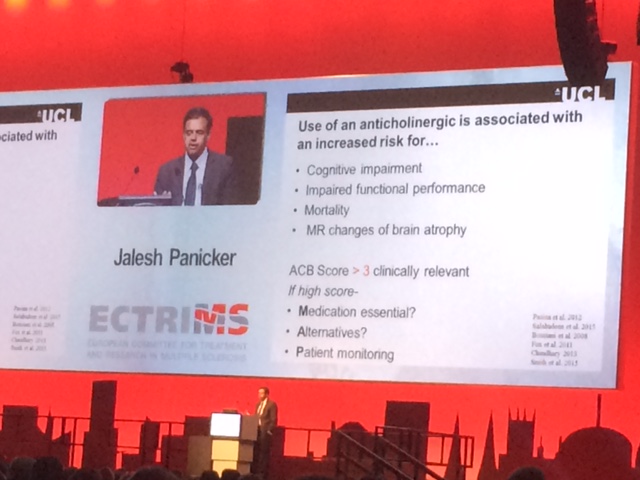
Treating MS bladder dysfunction – J. Panicker (UK)img_3967

Nothing new for me as an MS Nurse here; I’ll do a blog on the bladder; but confirmed the point I made earlier in this post about alternatives to anticholinergics that cause cognitive problems, and nice to see it being discussed. Add to that: Darifenacin or Tropsium if you can’t get Mirabegron.

Chasing the driver of fatigue in MS – V.Biberacher (Denmark)

Now this was really interesting. Why people get such fatigue in MS has always been a big question, and one that there are a lot of theories about. These investigators wanted to see
whether it was more associated with damage and lesion load in the brain, which can be measured by MRI scanning, or by inflammation, which can be measured by inflammatory markers in the cerebrospinal fluid ( CSF ) taken by lumbar puncture.

What they found, was that there was no significant relationship between damage and lesion load in the brain, but there was a significant relationship between inflammatory markers in the CSF. This suggests that inflammation, rather than structural damage, is responsible for fatigue in MS.

The take-home from this is that there are many ways to help reduce inflammation in your body – both your drug treatment, and lifestyle measures – eating an anti-inflammatory diet, getting good rest and sleep, becoming more resilient to stress, exercising, sunshine, vitamin D…

Dual lead deep brain stimulation for tremor – S. Oliveria (USA)

Study showing good effects on refractory ( ie won’t respond to any treatment/ drugs) tremor, in a small group of 11 people. 8 (73%) showed benefit at 6 months. 2 did not benefit; they had ataxia ( like clumsiness) rather than tremor. One got infected and had to have the leads removed. Kind of let down by the fact that they used a scale to show effectiveness, which didn’t show the actual result for the person’s functional improvement. So worth finding out about, but not a sure thing until we hear what the results of treatment for the actual people were. Grr!

Hot topic – bone marrow transplantation is a justifiable treatment for active relapsing remitting MS

Now I’m getting too hungry to report on this debate about stem cell /bone marrow

img_3972

When you want to be in two places at once….

 But I’ll try to finish this off tomorrow!

All the very best!

Miranda